
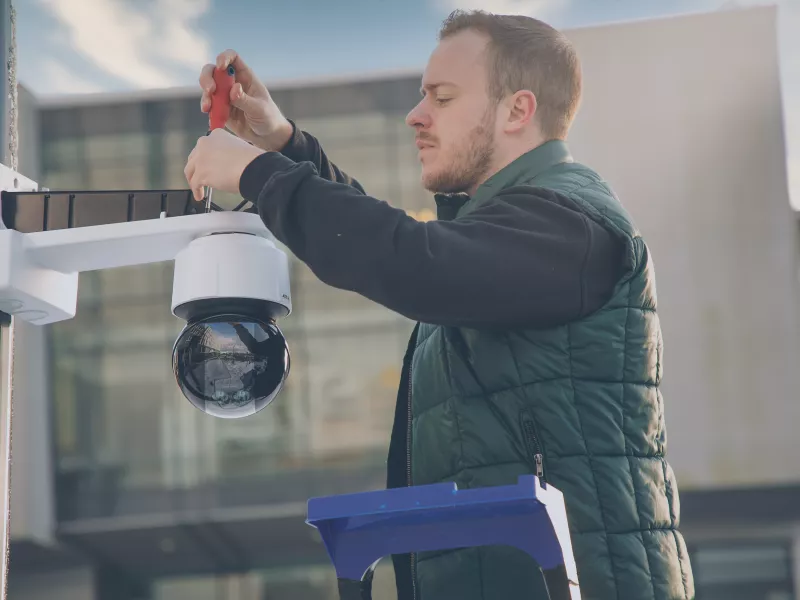
Quick answer: Farm security cameras protect Kansas property by deterring theft, recording evidence and letting you check barns, equipment yards and gates from your phone. The right setup pairs outdoor-rated cameras with dependable power and a signal that reaches remote buildings, often backed by professional monitoring when nobody is around.
If you run a farm in Kansas, you know the quiet part of the job. Nobody stands in the machine shed at 2 a.m. The nearest neighbor might be a mile off. A skid steer, a few hundred gallons of diesel and a trailer full of tools can sit in the open for days. For mobile equipment and vehicles, fleet and asset tracking can provide another layer of visibility by helping you monitor equipment locations and unexpected movement.
That gap is exactly what thieves count on. This guide covers how farm security cameras close it. We will look at what they protect, which camera types suit which spots, how remote video surveillance works when you are nowhere near the house, and what a clean install involves. Because we do electrical work too, the wiring and power side gets as much attention as the cameras.
In this guide
- Why farm theft goes unnoticed until morning
- What a camera does that a lock never will
- Choosing camera types, spot by spot
- Remote video surveillance for land you cannot watch in person
- Power, weather and placement: where farm installs succeed or fail
- What shapes the price of a farm camera system
- Ready to protect your property? Start with a walk around
Why Farm Theft Goes Unnoticed Until Morning
Farms are built for work, not for lockdown. Gates stay open so trucks can get through. Keys sit in the ignition because the next person to use the tractor is you, and you are in a hurry. That is normal. It is also why a property can be cleaned out without a single neighbor hearing about it.
What is actually on the line
- Equipment and attachments: skid steers, ATVs, trailers, implements
- Fuel and chemicals in tanks and sheds
- Tools, tack and spare parts that are easy to carry off
- Irrigation and electrical gear, including copper wire
- Livestock areas, where an open gate causes trouble all by itself
Distance changes the math
In town, a break-in might get spotted by a passing patrol or a porch light. Out on a county road, hours can go by before anyone sees a thing. By then the trailer is in another county. Cameras do not erase distance. They shrink the time between something happening and you knowing about it.
What a Camera Does That a Lock Never Will
Locks slow people down. Cameras change what they decide to do in the first place.
It makes your place a worse target
A visible camera, some light, a clear view of the gate. Someone hunting for an easy score tends to move along when a yard looks watched. No system makes a property untouchable, and we would never promise that. Still, a place that looks attended tends to get skipped more often than one that does not.
It leaves you with proof
When something does go missing, footage turns a vague report into a useful one. You get time stamps, the shape of a vehicle, the direction it left in. A county deputy can work with that. Your insurance company may ask for it as well. Without footage, you are describing a feeling.
Choosing Camera Types, Spot by Spot
No single camera suits a whole farm. A shop interior and a half-mile driveway are different problems, so we match the device to the job. Where a site calls for it, we install outdoor-rated Axis cameras. The right security camera system depends on the areas you need to cover, the lighting conditions and how you want to access recorded footage.
Machine sheds and barns
Indoors, a wide-angle dome or compact fixed camera covers the doorway and the equipment bays. We aim at the entry points first. Low-light performance matters more than a headline resolution number, since most barns are dim even at noon.
Equipment yards and fuel tanks
This is where bullet-style cameras with infrared night vision earn their keep. Mount them high enough to stay out of reach, and angle them so they catch faces and vehicles rather than a wide stretch of sky.
Fixed or PTZ?
A fixed camera watches one view, all the time. A pan-tilt-zoom (PTZ) camera sweeps a big area and can zoom in, but it can only look at one place at once.
How we usually pair them
Fixed cameras go on the choke points, like gates and doors. A PTZ on a pole covers the open yard. The fixed units never blink, and the PTZ supplies the bigger picture.
A word on resolution
More megapixels is not automatically better. A sharp image of the right spot beats a blurry one that tries to cover everything.
Driveways, gates and field access
A camera at the entry records every vehicle that comes and goes. Point it so cars approach head-on, not sideways, and you have a far better chance of reading a plate.
Livestock areas
Cameras here do two jobs. They watch for people who should not be there, and they let you check on animals without a midnight walk to the barn. You can also confirm a gate is latched before you go to bed.
Remote Video Surveillance for Land You Cannot Watch in Person
The point of remote video surveillance is plain. You see what the camera sees, from wherever you are, at the moment it matters.
Getting a signal out to the barn
There are three common routes. A wired network cable can run from the house or shop. A point-to-point wireless link can hop between buildings. Cellular works for sites with no network at all. Which one wins depends on distance, terrain and whether grain bins or tree lines are in the way. Once the connection is in place, cloud and local video recording options determine how footage is stored and accessed when you need to review an incident.
Alerts you will actually read
Motion alerts fire for deer, loose tarps and your own hired hand. Tune the zones and schedules so your phone buzzes for a person in the yard at 3 a.m., not a raccoon at 9 p.m. A system that cries wolf gets ignored.
When nobody is watching the screen
You are in the combine. Your phone is in the truck. For those hours, cameras can be tied into a monitored security system, so a trained operator sees the alert and acts on it. Our monitored systems are backed by 24/7 UL-listed monitoring. We can walk you through where that fits on your property.
Power, Weather and Placement: Where Farm Installs Succeed or Fail
Power comes first
A camera with no power is a decoration. Because we are electricians as well as security installers, this is where we spend a lot of time. Options include running power or PoE cable (long runs may need a switch, extender or fiber), trenching conduit to outbuildings, or using solar with a battery where trenching makes no sense. Add surge protection to long cable runs. Kansas storms are real, and one lightning strike can take out gear at both ends of a wire.
Weather and dust
Wind, heat, ice, grain dust, insects. Housings need the right rating, and lenses need to be reachable for cleaning. Bugs drawn to infrared light can also trigger false alerts, so placement matters here too.
Placement and lighting
Mount cameras high, but not so high that faces become blurs. Keep the lens out of direct sun at dawn and dusk. Add motion lighting where you can, because a lit yard helps the camera and tells a visitor they have been seen.
What Shapes the Price of a Farm Camera System
The honest answer is that it depends on the property. These are the pieces that move the number most:
- How many cameras you need and where they go
- Cable distance, trenching and power to outbuildings
- How the signal reaches each building
- Storage, remote access and whether you add monitoring
A real figure comes from seeing the site, not from a phone guess. If you want to see the range of work we handle, our page on security camera installation is a good starting point.
Ready to Protect Your Property? Start With a Walk Around
Hammeke installs security cameras in Kansas for farms, barns and remote properties, and the best first step is a conversation on the property itself. We walk the farm with you, note the weak spots, and map out cameras, power and signal before a single mount goes up. You decide what makes sense for your operation.
Call Hammeke at (620) 793-6704 or stop by 167 N US-281, Great Bend, KS 67530. You can also read more about Hammeke’s security solutions and send us a message from there.
Frequently Asked Questions
Do farm security cameras work without Wi-Fi or internet on the property?
Yes. Cameras can record to on-site storage with no internet at all. Viewing them remotely does need some kind of connection, and cellular is the usual fix when wired internet is not an option. Wireless links between buildings can help as well.
How many cameras does a farm actually need?
Fewer than most people expect, placed better. Start with entry points: gates, shop doors, the fuel tank and the main equipment lot. Add coverage where a walkthrough shows blind spots. The count follows risk, not acreage.
Will security cameras really stop farm theft?
They will not stop every attempt. They raise the odds that a thief skips your place, and they give you footage when one does not. Cameras work best alongside good lighting, solid locks and a habit of putting keys and fuel away.
Can cameras survive Kansas winters and summers?
Outdoor-rated cameras are built for heat, cold, wind and dust within their rated range. Mounting, housings and cable protection matter as much as the camera itself. Wipe the lenses now and then and they will keep doing their job.